The Power of Trust: Turning $100 into Compassionate Citizens
Why the Middle School Window sets the trajectory for a lifetime of service
By Sarah Screnock, Program and Development Lead
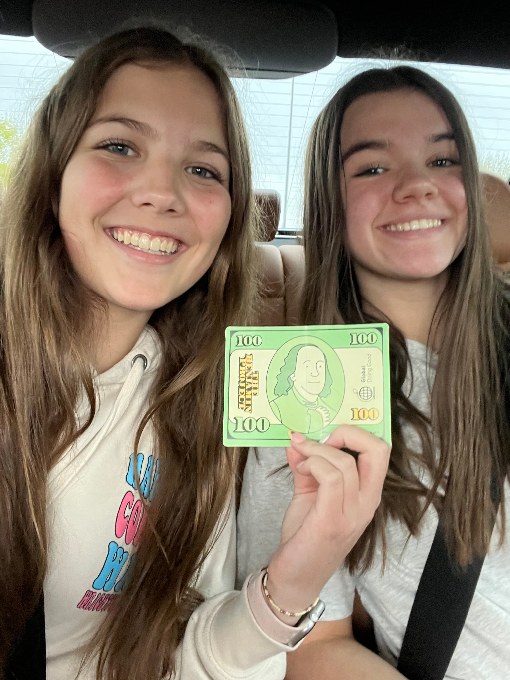
Brooklyn and Paisley supported Heartland Hope in Omaha, Nebraska.
At Global Doing Good, we believe all young people, no matter their background, have the potential to be informed citizens who make service a lifelong commitment. That's why we created The Benjamin Project: a simple but transformative program that gives middle school students $100 in seed money and challenges them to use it for good in their communities.
While we often hear from high school educators eager to bring this to their campuses, we remain focused on the middle school years for a strategic reason. This is more than simply a service learning project; we are setting a lifelong trajectory for service while the brain is in its most adaptive stage.
The Science of the Middle School Window
Middle schoolers are at a critical stage of development. They're beginning to form strong opinions, explore their identities, and notice the world around them in new ways. They want to be taken seriously. They want to matter.
The Benjamin Project treats students as capable participants in their communities today, meeting them with genuine trust and the power to act. This unique approach is backed by psychology and neuroscience:
1. The Rapid Growth Window
Developmental psychologists often call early adolescence (ages 11–14) the "Second Window of Neuroplasticity." Outside of the first three years of life, the brain never grows or changes as rapidly as it does during middle school.
The Impact: While high schoolers are certainly capable, the brain of a middle schooler is still structurally remodeling. By the time students reach 11th grade, many of their social habits and self-perceptions have already formed. By starting at age 11, we are working with a brain that is undergoing massive formation. The habits formed now—like active citizenship—become a permanent part of their adult identity.
2. The Identity Bridge: From Consumer to Contributor
According to Erikson's Stages of Development, middle schoolers are crossing the "Identity Bridge." They are moving from a stage of Industry (the need to feel competent and productive) toward Identity (the need to understand who they are in the world). This is the moment they apply their skills to discover their purpose.
The Impact: While the classroom provides the essential foundation of knowledge, The Benjamin Project offers educators a way to invite students into a new, expanded role. By providing radical autonomy, we move students from being consumers (participants in a curriculum) to contributors (active citizens in their community). Proving they are capable of impacting their world provides the sense of industry they need to successfully bridge into a confident, active identity.
3. The Social Brain & The Developmental Gap
Middle schoolers are uniquely sensitive to social rewards. Research highlights a "Developmental Gap" unique to this age: the limbic system (the brain's reward center) is fully online and hyper-sensitive to social impact, while the prefrontal cortex (the rational center) is still structurally remodeling. This gap is why middle schoolers feel things so deeply and are so driven by social connection.
Adolescent brains have been likened to a high-performance sports car that just got a massive engine upgrade, but still has the brakes of a bicycle. The gap is the period (starting around age 11) where the accelerator is pushed to the floor, but the brakes aren't fully installed yet. This explains why a 13-year-old gets so excited about a $100 donation—it's literally how their brain is wired to respond.
The Impact: Often this gap is viewed as a risk factor. However, by partnering with educators to provide a $100 mission, we turn that accelerator into a force for good. We provide a high-reward outlet where the dopamine hit doesn't come from a screen or a risk, but from the profound social win of serving in their communities. This allows students to practice the exact skills—planning, budgeting, and empathy—that help the prefrontal cortex catch up. By giving them a mission to make a difference, we tap into their natural drive for social connection. When they see their $100 meet needs in their communities, the social win fires their reward system and feels more powerful to a 12- or 13-year-old than it does to almost any other age group.
Case Study: The Middle School Window
The Hypothesis
If we replace traditional adult-led service learning models with radical student autonomy, middle schoolers will demonstrate an immediate capacity to act as effective, active philanthropists.
The Evidence
We tracked the impact of 435 students nationwide over a period of 90 days who were each given a $100 seed grant and the directive to make a difference in their community. Because the program is designed to be "hands-off" for adults, the students were the primary decision-makers from day one.
The Results
Agency in Action: Students immediately took charge. They identified local needs—from animal welfare and food security to homeless support and even starting non-profits—managing every project detail on their own terms.
The 90-Day Multiplier: In just three months, these students generated an additional $44,388 in direct cash. They more than doubled our initial investment before a single donated service was factored in.
The ROI: This 100% return in just 90 days is a data point proving middle schoolers are a high-impact force for good. When entrusted with real responsibility, they far exceed expectations.
The Conclusion
Science shows that early adolescence is the most significant period of brain formation since the first three years of life. When we capitalize on this unique window, students prove they are capable of remarkable things. By reinforcing these neural pathways while the brain is in a formative period, we set a trajectory for a lifetime of service and active citizenship.
Building Compassionate Citizens
The success of these projects goes far beyond the immediate results; it is found in the visible, profound shift in how a student sees their own potential. These are the moments that shape their identity. Through The Benjamin Project, students develop the strength of character they need to navigate the world with agency and purpose:
Confidence: By taking real-world risks with real-world capital, students move from "Can I do this?" to "I am the one who does this."
Resilience: In a safe, educator-supported environment, students learn that a setback or a "no" is simply a data point—a challenge to be solved rather than a reason to stop.
Active Empathy: Students move from feeling for someone to acting for someone. They transition from discovering a need to addressing it, learning that compassion is most powerful when it leads to real world change.
Belonging: They realize they are not just unseen observers of their communities; they are essential partners whose contributions make their community stronger.
By reinforcing these traits during the middle school window, we aim to touch countless lives—not just the students', but the individuals they serve—by inspiring a lifelong trajectory of curiosity, compassion, and global citizenship.
The Power of a Simple Mission
The Benjamin Project begins with a single act of trust. Every student is given the same challenge:
"I'm entrusting you with $100. Go and make a difference in your community!"
This radical autonomy is the catalyst. By handing middle schoolers real capital and the freedom to invest it, we signal that they are already essential citizens in our world. We aren't asking them to practice for a distant future; we are inviting them to take ownership of the present.
When we partner with educators to open this window of opportunity, we do more than just fund a project—we lay the foundation for a lifetime of active citizenship. We help students discover the profound, addictive joy of bettering their communities and themselves.
If you're an educator, parent, or community member who believes in the power of young people, we invite you to join us. By trusting middle schoolers with the resources and autonomy to make a difference in their communities, we are going beyond a simple lesson in social learning. We are helping form curious, engaged citizens who are excited about a lifetime of service.
Support The Benjamin Project and help us open this window of opportunity for more middle schoolers across the country.